The tuning fork program cart consists of a variety of different size tuning forks with different frequencies. These tuning forks provide hand-on discovery with resonance and pitch.
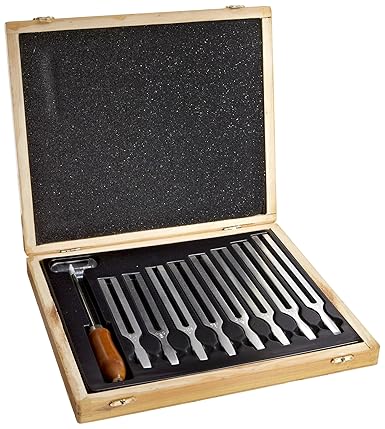
I start off this program cart by allowing guests to experiment with the different tuning forms and make observations. Typically guests will strike the forks and move them to and from their ear. Experimenting with the tuning forks often leads to a conversation about how the tuning forks create a sound. When you strike the fork it vibrates back and forth. With the large tuning fork, you are able to see the fork vibrating. You can also demonstrate this by using a ball on a string. You can also demonstrate the vibrations of the tuning fork by striking it and dipping the fork into a cup of water.
Ask guests what they notice about the different sizes of the tuning forks. This often leads to a conversation about size, speed of vibrations and pitch. The smaller the tins on the tuning fork, the less distance it has to move and the faster it will vibrate. This is something that can be demonstrated with the yard stick as well. The shorter the distance the yard stick is off of the table, the faster it will vibrate and vise versa. Through experimentation, the guests often then make the connection that the smaller tuning forks have a higher pitch. Smaller = faster vibrations (higher frequency) = higher pitch. Larger = slower vibration (lower frequency) = lower pitch. Encourage the guests to make similar observations on the giant guitar and the oscylinderscope.
Encourage guests to continue to be creative and come up with other experiments that can be done using the tuning forks.
Some ideas include:
- Ball on a string; Hold the string and strike the tuning fork. Carefully bring the ball to the tuning fork tins and the vibrations created will move the ball.

- Hold the tuning fork base on different parts of your body and feel the vibration (placing the tuning fork on the forehead and on the bone behind the ear is a way to factor out certain types of hearing loss)
- Strike the tuning fork and then gently place tins into a cup of water

- Spin the fork as you listen
- Strike the tuning forks and place the base on different objects such as the table, windows, floor, etc. (increases amplitude of sound)
- Create chords or play a song with a group of people
The possibilities are endless!

No comments:
Post a Comment