Mindball-
When I facilitate mindball I often start by watching the guests play the game. I find by just being available to the guests they often will start asking me questions about how to play the game and how the game works. When asked how to play the game, I respond with press the button to begin, place your forehead on the headrest and relax. Afterwords, we have a conversation about what happened and I ask for their hypothesis on how the ball is being moved. Pulse, pressure, concentration, are all responses I get often. If its something they can test, I encourage them to test their hypothesis. I also encourage them to look at the graph and hypothesize what the graph is showing. After the guests are able to make predictions and test some hypothesis, I explain that mindball is measuring alpha waves which are associated with relaxation. With this information, guests often want to run new experiments with the game.
Oscylinderscope-
I feel that modeling behavior is a big part of getting people to experiment with the oscylinderscope. I will often stand and play with the oscylinderscope to draw peoples attention. This usually results in someone coming over and observing me and I encourage them to come test it out. I continue to ask them what more they can do with it and help them explore all of the parts. I ask questions like what do you think this is showing? Why do you think it looks different at different speeds/push down he peddle? To encourage them to a higher engagement level I often give challenges such as seeing if they can change the shape of the strings, make the strings change direction, or simply encouraging them to keep playing and exploring which is often how you discover new things about an exhibit!
Friday, November 30, 2018

Thursday, November 29, 2018
Presentation Responses (Matthew and Angela) - Destiny
ANGELA- X-rays and light table
I have facilitated this exhibit with many children. Usually I start when guests are already playing with the toys. This gives me a good starting point to talk about their parts. Then I can pull out the x-rays and make the connection.
I usually ask questions like these:
- Have you ever had an x-ray before?
- Do you know what an x-ray is?
Then I can direct the questions to be more about the toys. I agree with Angela that VTS facilitation works best. Asking visitors what they see and then asking them what makes them say that since we can't see inside the toy.
I maximize engagement at this exhibit by having the guest make the connection between the toys and the x-rays themselves since they are not so obvious to all. I optimize practice by really focusing on the x-rays and the observations they are making. They may see the shape of the toy but not realize there are batteries since you can not see the batteries on the toy itself. I would expand practices by having the guest construct explanations of how x-rays take pictures of insides of solid objects.
MATTHEW- sound machine
The sound machine is very eye and ear catching which grabs guest's attention easily. This makes initiating facilitation easier.
I start with questions like:
-Have you watched the balls go on every parts of the tracks?
-Have you figured how it changes tracks?
-What would be different if we switched the balls to a different material/ weight?
I can maximize engagement by having the guest watch a specific part of the track and make a prediction on how many balls will launch before it goes over that part of the track. I can optimize the practice that the guest is using by having them observe how long it takes in between each ball launch and how that affects or does not affect how they travel down the track. Lastly, I would expand their interaction with other practices by suggesting that they try to figure out how many different tracks or ways a ball can travel from beginning to end if they are already counting balls or observing the balls pathways.
Monday, November 26, 2018
Improv - Danielle Tisdale
Improv was hard for me. I am comfortable with talking
in front of children, but I still struggle with it in front of adults. Improv
forced me out of my shell and made me grow more comfortable speaking in front
of adults, but it is still hard for me. I need to keep growing in that area, but
I personally felt like improv was too far out of my comfort zone to be as
helpful as it could’ve been. I also
think that while some of the improv activities were fun, but I personally felt
very out of my depth trying to come up with ideas or scenes out of the blue. I think
for me, it would’ve been more helpful to work on improvising with things based
on our exhibits or some of the field trip programs we have. As a Spark, we
always have a basic idea of how our exhibits work so we won’t need to come up
with something out of the blue like we had to for improv. Even in other careers,
unless we go into improv, we probably won’t need to completely improvise something.
It seemed to me to be over preparation for something that probably won’t happen.
Overall, I think it was probably more beneficial to me than I am giving it
credit for, but it was also difficult and a little stressful. The best part
about improv was getting to know the other Sparks better and playing some of
the games.
Sunday, November 25, 2018
Tuning Forks - Angela S.
Tuning Forks Program Cart:
The tuning fork program cart consists of a variety of different size tuning forks with different frequencies. These tuning forks provide hand-on discovery with resonance and pitch.
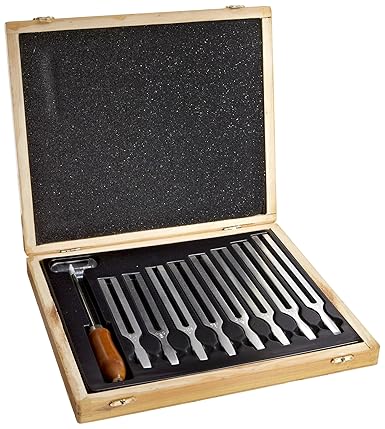


The tuning fork program cart consists of a variety of different size tuning forks with different frequencies. These tuning forks provide hand-on discovery with resonance and pitch.
I start off this program cart by allowing guests to experiment with the different tuning forms and make observations. Typically guests will strike the forks and move them to and from their ear. Experimenting with the tuning forks often leads to a conversation about how the tuning forks create a sound. When you strike the fork it vibrates back and forth. With the large tuning fork, you are able to see the fork vibrating. You can also demonstrate this by using a ball on a string. You can also demonstrate the vibrations of the tuning fork by striking it and dipping the fork into a cup of water.
Ask guests what they notice about the different sizes of the tuning forks. This often leads to a conversation about size, speed of vibrations and pitch. The smaller the tins on the tuning fork, the less distance it has to move and the faster it will vibrate. This is something that can be demonstrated with the yard stick as well. The shorter the distance the yard stick is off of the table, the faster it will vibrate and vise versa. Through experimentation, the guests often then make the connection that the smaller tuning forks have a higher pitch. Smaller = faster vibrations (higher frequency) = higher pitch. Larger = slower vibration (lower frequency) = lower pitch. Encourage the guests to make similar observations on the giant guitar and the oscylinderscope.
Encourage guests to continue to be creative and come up with other experiments that can be done using the tuning forks.
Some ideas include:
- Ball on a string; Hold the string and strike the tuning fork. Carefully bring the ball to the tuning fork tins and the vibrations created will move the ball.
- Hold the tuning fork base on different parts of your body and feel the vibration (placing the tuning fork on the forehead and on the bone behind the ear is a way to factor out certain types of hearing loss)
- Strike the tuning fork and then gently place tins into a cup of water
- Spin the fork as you listen
- Strike the tuning forks and place the base on different objects such as the table, windows, floor, etc. (increases amplitude of sound)
- Create chords or play a song with a group of people
The possibilities are endless!
Tuesday, November 20, 2018
Tuning Fork Boxes - Kevin
These mounted tuning forks can be used to dramatically demonstrate the phenomena of resonance and beats. You’ll need:
- 2 tuning forks mounted on boxes
- 1 mallet to strike them
- 1 ping pong ball on a string
- A few plastic combs
This works best on the first floor near the Sound Track. Set up the boxes so that the holes are facing each other. One of the tuning forks is adjustable. Make sure that both of the weights on the adjustable tuning fork are aligned with the lower marks on the tuning fork.
When guests approach, tell them that you are conducting an experiment using sound or tuning forks. Show that hitting the tuning forks makes a sound. (It works best to hit the fork directly on the weight.) They can make observations at this point like that both forks make the same sound, they vibrate, etc. You can also show how the sound stops when you grab the fork to make it stop vibrating.
Now show what happens when you just hit one of the forks. Let it ring for a moment and then grab it to stop its sound. You can even pull it away from the table. The other fork will still be ringing. What’s happening? We didn’t hit that fork but it’s still making sound! The guest might make observations like the first one is making the second one vibrate or the sound is hitting it and making it move. Your next tool can explore if that second fork is moving.
Have the guest hold a ping pong ball on a string so that the ball is balanced against the second tuning fork. Now hit the first fork. It will make the ping pong ball dance. I like to give plenty of time to let the guest wonder before prompting them. They usually start making claims on their own. I try to follow the guest at this point - they might say the vibrations are going through the table. They can try holding them in the air (with a friend) to test this. They might want to try changing the position of the weights. I’ll ask what they think is going on and restate their observations and claims but stay away from telling them what is happening.
If the guest is engaged, I’ll say there’s another experiment we can try. First show them what happens when you hit both of the forks (answer: not much). Now move one of the weights so that it’s aligned with the higher mark on the tuning fork. Hit both of the forks. The sound has changed. Sometimes they think one is louder, but usually they notice that it’s making a pulsing sound. I tell them that there is a cool way to visualize what is happening. Hold up one of the combs and look through it. Hold it above one of the forks and say, “Pretend this is the first sound.” The other comb is the second sound, very similar but slightly different. Now when you hold them on top of each other, they make a new pattern. Strike the forks separately connecting them to the visual of the fork. Now hit both and put the combs on top of each other (i.e. one in front of the other so that you’re looking through the teeth of both). Let the guests experiment with the forks and ask what they think is happening. They might say something about sound waves which makes a great segue to direct them to the oscillating guitar strings to continue their exploration of sound!
Monday, November 19, 2018
Spoon on a string - description and questions, Sam S.
The spoon on the string is used as a learning tool in the sound resonance program cart. It consists of a large, fully-metal serving spoon with a hole at the end of the handle for hanging on a peg or rack. Through the hole a short paracord is strung with a loop on either end, large enough to fit one's fingers through.
When you hold the paracord and swing the spoon to hit a table, it makes a short, high clanging sound. However, if you put your fingers through the loops at the end of the chord and put them in your ears, the sound produced by hitting the spoon is much deeper, fuller, and longer lasting. It seems that sound waves are much more easily translated through the string than they are through the air, which makes the sound louder and last longer as the wave bounces back and forth between either end of the paracord.
This learning tool prompts a slew of different questions:
- Why does it sound louder when the string is "attached" to your ears?
- Why does the sound last longer when the string is attached to your ears?
- The tone is different with the string in your ears. It's fuller, with more notes, and lower overall. Why would this be?
- Is the sound you hear unique to this particular spoon? How might another metal object sound?
- Is this only possible with metal? What would a wooden or plastic spoon sound like?
- What if there was something to dampen the vibrations of the spoon, like some foam or water? How would that sound?
- How would this all sound underwater? Both with fingers in ears and without.
- Why can you only hear the lower notes when your fingers are in your ear?
- Does the sound change based on where you hit the spoon?
- Does the sound change based on what you hit the spoon with?
I don't know the answer to all of these questions, but they would be worth investigating. I do know that sound waves travel much more easily through the paracord than they do through air. Put another way, when the spoon is struck, it's vibrations have to displace air molecules, which then have to travel to your ear and vibrate the solid and liquid parts of your ear drum. Lots of sound waves are attenuated through this process. Conversely, when your fingers are in your ear, the sound vibrations can travel from the solid spoon, along the solid paracord, through your solid fingers, and into your eardrum. More sound waves, especially lower frequency waves, can reach your ear drum this way. Furthermore, as the spoon keeps vibrating, you can better hear further reflections of the vibrations for a longer time.
Some basic concepts and themes beyond sound resonance to explore with this item: forces (hitting the soon), materials science (metal vs. other material, shape of the object).
-Sam S.
When you hold the paracord and swing the spoon to hit a table, it makes a short, high clanging sound. However, if you put your fingers through the loops at the end of the chord and put them in your ears, the sound produced by hitting the spoon is much deeper, fuller, and longer lasting. It seems that sound waves are much more easily translated through the string than they are through the air, which makes the sound louder and last longer as the wave bounces back and forth between either end of the paracord.
This learning tool prompts a slew of different questions:
- Why does it sound louder when the string is "attached" to your ears?
- Why does the sound last longer when the string is attached to your ears?
- The tone is different with the string in your ears. It's fuller, with more notes, and lower overall. Why would this be?
- Is the sound you hear unique to this particular spoon? How might another metal object sound?
- Is this only possible with metal? What would a wooden or plastic spoon sound like?
- What if there was something to dampen the vibrations of the spoon, like some foam or water? How would that sound?
- How would this all sound underwater? Both with fingers in ears and without.
- Why can you only hear the lower notes when your fingers are in your ear?
- Does the sound change based on where you hit the spoon?
- Does the sound change based on what you hit the spoon with?
I don't know the answer to all of these questions, but they would be worth investigating. I do know that sound waves travel much more easily through the paracord than they do through air. Put another way, when the spoon is struck, it's vibrations have to displace air molecules, which then have to travel to your ear and vibrate the solid and liquid parts of your ear drum. Lots of sound waves are attenuated through this process. Conversely, when your fingers are in your ear, the sound vibrations can travel from the solid spoon, along the solid paracord, through your solid fingers, and into your eardrum. More sound waves, especially lower frequency waves, can reach your ear drum this way. Furthermore, as the spoon keeps vibrating, you can better hear further reflections of the vibrations for a longer time.
Some basic concepts and themes beyond sound resonance to explore with this item: forces (hitting the soon), materials science (metal vs. other material, shape of the object).
-Sam S.
Sunday, November 18, 2018
A Resounding Demonstration (The Resonance Bowl Program Cart)
Observed phenomenon of program cart:
The resonance bowl demonstrates how friction between wet hands and the handles can create a vibration seen in water filling the bowl.
A couple of demonstrations I observed this week:
Juliana was at the program cart when a guest presented an idea utilizing the tuning forks. When the tuning forks are hit and touch the water various splashing strengths can be observed. The level of splash rubbing the handles creates is similar to the lowest HZ tuning fork.
William, a volunteer, created a large splash and what sounded like a few different notes. His hands are quite large with more surface area and his palms seem more arched. I wonder if the hand shape and duration of rubbing has an effect on the height of splash.
Matthew was at the program cart and used the rubber mallets to create the same effect rubbing the handles does. This is an effective method for younger kids who have a harder time rubbing the handles to create the resonance.
When Stephanie suggested using the violin bow to generate vibrations, it might have been interesting to see if the effect could be seen better in a bowl filled with sand rather than water.
Using soap to create bubbles and show the movement of the waves was helpful. It might be further helpful to use a floating object, such as a cork, to demonstrate the wave motions in the bowl.
Potential questions to ask and engage guests with:
What do you think this is?
What do you think will happen if I rub the handles?
Why do you think rubbing the handles causes this to happen?
What do you think will happen if we add water?
What do you think will happen if we remove water?
What do you see happening in the water?
Why do the ripples only form in certain spots?
Do you think we can change where the ripples form? How?
Basic concepts involving the resonance bowl:
Chladni patterns
Transverse waves
Standing waves
Antinodes
Nodes
-Samantha Brown
The resonance bowl demonstrates how friction between wet hands and the handles can create a vibration seen in water filling the bowl.
A couple of demonstrations I observed this week:
Juliana was at the program cart when a guest presented an idea utilizing the tuning forks. When the tuning forks are hit and touch the water various splashing strengths can be observed. The level of splash rubbing the handles creates is similar to the lowest HZ tuning fork.
William, a volunteer, created a large splash and what sounded like a few different notes. His hands are quite large with more surface area and his palms seem more arched. I wonder if the hand shape and duration of rubbing has an effect on the height of splash.
Matthew was at the program cart and used the rubber mallets to create the same effect rubbing the handles does. This is an effective method for younger kids who have a harder time rubbing the handles to create the resonance.
When Stephanie suggested using the violin bow to generate vibrations, it might have been interesting to see if the effect could be seen better in a bowl filled with sand rather than water.
Using soap to create bubbles and show the movement of the waves was helpful. It might be further helpful to use a floating object, such as a cork, to demonstrate the wave motions in the bowl.
Potential questions to ask and engage guests with:
What do you think this is?
What do you think will happen if I rub the handles?
Why do you think rubbing the handles causes this to happen?
What do you think will happen if we add water?
What do you think will happen if we remove water?
What do you see happening in the water?
Why do the ripples only form in certain spots?
Do you think we can change where the ripples form? How?
Basic concepts involving the resonance bowl:
Chladni patterns
Transverse waves
Standing waves
Antinodes
Nodes
-Samantha Brown
Thursday, November 15, 2018
Rubber mat - Destiny
The rubber mat is a very simple looking black, square rubber mat that has a handle in the middle. This is deceiving because it actually does something that is quite awesome despite its strength when placed on a flat solid object.
Simply when placed on a flat solid object like a table and then pulled up on the knob the rubber sticks so hard that it actually could lift up the table. The bottom is not sticky so the only explanation is that it is like a suction cup. When it is flat it gets rid of all the air underneath changes the air pressure. The air pressure on the outside pushes the rubber mat on to the table.
This rubber mat can raise many questions. Why is it easy to slide around on the surface of the table yet difficult to lift up? Does the shape affect its strength? What is the capacity of the weight?
When the seal is released it allows air to get under it and change the air pressure and makes it easy to pick up. One test you can do is slide the rubber mat off the edge of the table until it comes off. This usually happened at about one-third of the way off the table. Or you could lift one corner and allow air underneath to pick it up. You could also test if it works on surfaces that are not solid or on vertical surfaces. I tested it on the glass door and it held my entire weight.
Wednesday, November 14, 2018
Density Bottle- Juliana


The density bottle is a mysterious bottle that contains liquids
of different densities and white and blue beads. When you shake the bottle,
everything in the bottle gets mixed up and there are no clear layers. Once the
bottle has been at rest for a few seconds, you can see the different layers
separate. The blue beads go to the bottom of the bottle, the white beads go to
the top, and the liquids remain mixed in the middle. When the bottle has had
about a minute to rest, the blue beads move up and the white beads move down
until they have met in the middle.
The mystery of the bottle is that because the liquid in the
bottle is clear, it appears to all be the same liquid. So when someone first
looks at the bottle, they are puzzled by the clumping of the beads in the
center of the bottle, as well as the separation of the blue and white beads.
This mystery provides an opportunity for observers to question whether the
liquid really is water, or if it is something else. And when you look very
closely at the liquid, you can see that the liquid that floats to the top of
the bottle does actually have some very tiny particles in it that make it clear
that it is not water, while the clearer liquid on the bottom most likely is
water.
While playing with the density bottle on Tuesday, someone
mentioned that the density bottle reminded them of salad dressing, because when
you leave salad dressing to sit for a while, the different parts separate,
which was similar to what happened with the density bottle. Another connection that was
made in class was how the density bottle was similar to a Venn diagram when the
beads are separated on the top and the bottom, with the pure liquids below the
blue beads and above the white beads. Making connections to outside experiences
is an important part of scientific discovery. Asking what outside connections can
be made to exhibits is a great way to engage visitors because it encourages them to be creative and think outside the box.
Another idea that came up in class was how normally when you have liquids of different densities in one container, you can see a distinct line between the liquids when they are separated. For example, when you have water and oil in a container, you can clearly see where the oil is sitting on top of the water. In the density bottle, however, this line is not as clear because the beads are covering up this line. It may be interesting to have a second bottle that also has these two different liquids, but without the beads so that this separation may be clearer to observers.
Tuesday, November 13, 2018
"Density bottle" - Sophia Rowen
The density bottle is a clear bottle with clear liquid and white beads and blue beads inside. You can pick it up, look at it and shake it. At first, the phenomenon to be observed is not obvious. I myself stood there and shared the bottle for minutes until I realized something significant about the beads. After aggressively shaking the bottle, I watched as the white and blue beads separated from each other. The white beads found themselves hovering above the blue beads and stayed this way until finding themselves closer together again- but still not mixed. You can lay the bottle sideways and the beads have a similar behavior, they don't mix.
Then you notice the appearance of the liquid inside the bottle. It has particles floating around and you think to yourself, hmm this probably isn't just water then. You might begin to think that it is a mixture of some oil and water. So now you notice that the liquid inside is of a certain density, and you infer that the different color beads have different densities as well. This would make sense since the blue beads float below the white beads, making the blue beads more dense than the white beads.
You can even put the density bottle out in the sun. After being in the sun for a couple minutes, the liquid inside the bottle has separated and the top is now yellow while the bottom is clear. The white beads still float above the blue beads yet the color of the water is now yellow on the upper half of the bottle. This occurs because the white beads are actually UV beads.
The density bottle gets people to think like engineers. The phenomenon observed forces people to investigate the properties and uses of the materials. By shaking the bottle and observing what happens you are able to make evidence based decisions, envision solutions, and assess the implications of those solutions. I found that those around me were able to communicate what they believed to be happening with the help of facilitation. In this sense, it is beneficial to work in teams because more ideas are put forth and attempted.
At the end of exploring the density bottle, I came up with some questions that guests or I might propose: can we have a separate density bottle with no beads? and what would happen if we used a different sized bottle? and Have you experienced something similar to this phenomenon in your everyday life?

Then you notice the appearance of the liquid inside the bottle. It has particles floating around and you think to yourself, hmm this probably isn't just water then. You might begin to think that it is a mixture of some oil and water. So now you notice that the liquid inside is of a certain density, and you infer that the different color beads have different densities as well. This would make sense since the blue beads float below the white beads, making the blue beads more dense than the white beads.
You can even put the density bottle out in the sun. After being in the sun for a couple minutes, the liquid inside the bottle has separated and the top is now yellow while the bottom is clear. The white beads still float above the blue beads yet the color of the water is now yellow on the upper half of the bottle. This occurs because the white beads are actually UV beads.
The density bottle gets people to think like engineers. The phenomenon observed forces people to investigate the properties and uses of the materials. By shaking the bottle and observing what happens you are able to make evidence based decisions, envision solutions, and assess the implications of those solutions. I found that those around me were able to communicate what they believed to be happening with the help of facilitation. In this sense, it is beneficial to work in teams because more ideas are put forth and attempted.
At the end of exploring the density bottle, I came up with some questions that guests or I might propose: can we have a separate density bottle with no beads? and what would happen if we used a different sized bottle? and Have you experienced something similar to this phenomenon in your everyday life?

Improv -- Stephanie
I think the most beneficial part of improv for me was that it reinforces the idea that we don't have to know every answer in order to facilitate effectively. The practice of not anticipating what is coming next can be really difficult and I definitely struggled with that, however, when you get the hang of it, I think it becomes extremely valuable in any educational setting.
In the past, I have performed skits that were prepared ahead of time and had a scripts. I have always disliked these types of situations which made it difficult for me to volunteer to do a scene during improv but once I forced myself to do it, I actually found it easier than a scripted skit. I think that not having a specific way it is supposed to be done took some of the pressure off as there is no wrong way to do improv and that further supports that not knowing the answer is okay. And at MOXI, not knowing the answer may even be more valuable than knowing it!
In the past, I have performed skits that were prepared ahead of time and had a scripts. I have always disliked these types of situations which made it difficult for me to volunteer to do a scene during improv but once I forced myself to do it, I actually found it easier than a scripted skit. I think that not having a specific way it is supposed to be done took some of the pressure off as there is no wrong way to do improv and that further supports that not knowing the answer is okay. And at MOXI, not knowing the answer may even be more valuable than knowing it!
Monday, November 12, 2018
Epistemic Engineering Practices at the Bloom Build and Roll-It Wall - Sam S.
In observing guests employing STEM practices at MOXI, I chose to focus on two very different exhibits: the Bloom Build blocks and the Roll-It Wall. Being so different in nature, each exhibit lends itself to different STEM and epistemic practices.
Bloom Build blocks lend themselves more to open creative projects, often without predetermined objectives. As such, some of the most frequent STEM practices I saw guests engage in were envisioning multiple solutions, applying science knowledge, investigating properties and uses of materials, and, most importantly, persisting and learning from failure. I've mostly seen guests playing with the Bloom Builds on their own, without a specific goal from the onset. However, even without a preset design goal, the asymmetrical blocks lead to falling blocks or a shifting structure as additional blocks shift the center of gravity. Guests adjust to this common occurrence by undoing their previous block placements, adding new ones, or by continuing to build on the new equilibrium with greater knowledge of how the unstable the structure is. In all of these adjustments, they are learning from failure, investigating properties of materials, and also envisioning multiple solutions as they anticipate the implications of further block placements. In the rarer events that guests use the bloom build blocks with a preset design or challenge, they expand the possibility of incorporating epistemic engineering practices. Guests with a certain design challenge in mind would be forced to make trade-offs between criteria and constraints, most likely by accommodating the asymmetrical blocks by changing their initial design. They would then be forced to envision multiple solutions, as they adjusted to the constraints posed by the blocks. They may also work in a team, if more than one person is working on the design.
While Bloom Build is quite open ended and organic in it engages guests, the Roll-It Wall is far more determinative in nature. While guests have the freedom to make their own goals, they will generally consist of making a ball complete a track with multiple features, beginning on one end. While this seems more constrained overall, it lends itself much more to collaborative engineering practices. I've most often seen guests operating in pairs, in any combination of child/adult/boy/girl/teacher/student. These pairs of guests often have some objective, whether it's a large track-scale design, or simply determining how to keep the ball from falling of the track in the middle of a dip. Guests most often engage in the epistemic practices of envisioning multiple solutions, making trade-offs between criteria and constraints, persisting and learning from failure, and most frequently, working in teams and engaging in argument from evidence. I've often seen guests holding the ball and running it along the track in slow motion, arguing to their partner how they think it behaved in the previous test and why. I've seen guests trade off leads on designing parts of the track, based on who has gone previously. The roll it wall also encourages guests to incorporate their existing knowledge of science. I've frequently seen children and adults talking about the energy the ball needs to complete a loop, or to overcome a hill, without necessarily using the words "potential energy," but still accessing their understanding of physical behavior nonetheless. Guests often are limited by the time they are willing to spend at the exhibit, or by the difficulty of affixing the rubber track to the pins, if they are young. In the rare instances that they persevere through these limitations and spend a long time at the Roll-It Wall, guests may proceed to employ math knowledge (potential energy and comparing hill height/friction), and investigate the properties and uses of materials (behavior of different balls).
-Sam Shaw
Bloom Build blocks lend themselves more to open creative projects, often without predetermined objectives. As such, some of the most frequent STEM practices I saw guests engage in were envisioning multiple solutions, applying science knowledge, investigating properties and uses of materials, and, most importantly, persisting and learning from failure. I've mostly seen guests playing with the Bloom Builds on their own, without a specific goal from the onset. However, even without a preset design goal, the asymmetrical blocks lead to falling blocks or a shifting structure as additional blocks shift the center of gravity. Guests adjust to this common occurrence by undoing their previous block placements, adding new ones, or by continuing to build on the new equilibrium with greater knowledge of how the unstable the structure is. In all of these adjustments, they are learning from failure, investigating properties of materials, and also envisioning multiple solutions as they anticipate the implications of further block placements. In the rarer events that guests use the bloom build blocks with a preset design or challenge, they expand the possibility of incorporating epistemic engineering practices. Guests with a certain design challenge in mind would be forced to make trade-offs between criteria and constraints, most likely by accommodating the asymmetrical blocks by changing their initial design. They would then be forced to envision multiple solutions, as they adjusted to the constraints posed by the blocks. They may also work in a team, if more than one person is working on the design.
While Bloom Build is quite open ended and organic in it engages guests, the Roll-It Wall is far more determinative in nature. While guests have the freedom to make their own goals, they will generally consist of making a ball complete a track with multiple features, beginning on one end. While this seems more constrained overall, it lends itself much more to collaborative engineering practices. I've most often seen guests operating in pairs, in any combination of child/adult/boy/girl/teacher/student. These pairs of guests often have some objective, whether it's a large track-scale design, or simply determining how to keep the ball from falling of the track in the middle of a dip. Guests most often engage in the epistemic practices of envisioning multiple solutions, making trade-offs between criteria and constraints, persisting and learning from failure, and most frequently, working in teams and engaging in argument from evidence. I've often seen guests holding the ball and running it along the track in slow motion, arguing to their partner how they think it behaved in the previous test and why. I've seen guests trade off leads on designing parts of the track, based on who has gone previously. The roll it wall also encourages guests to incorporate their existing knowledge of science. I've frequently seen children and adults talking about the energy the ball needs to complete a loop, or to overcome a hill, without necessarily using the words "potential energy," but still accessing their understanding of physical behavior nonetheless. Guests often are limited by the time they are willing to spend at the exhibit, or by the difficulty of affixing the rubber track to the pins, if they are young. In the rare instances that they persevere through these limitations and spend a long time at the Roll-It Wall, guests may proceed to employ math knowledge (potential energy and comparing hill height/friction), and investigate the properties and uses of materials (behavior of different balls).
-Sam Shaw
Cunningham Reading and Getting Specific on Mystery Tubes - Kevin
Some thoughts on, "Epistemic Practices of Engineering for Education."
I really enjoyed this article. It seems so obvious to look at the practices and knowledge base of professional engineers to develop new pedagogical approaches to engineering. I am glad that the authors emphasize the social aspect of engineering. In my experience, this seems to have taken a back seat to having students invent solutions.
The authors focus on the idea that engineers must be able to communicate their ideas to be successful. I’d like to use this more in engineering lessons. Maybe have students design different phases of a solution that need to be incorporated after they’ve been built. This could also help address the idea of having to find a balance between constraints and criteria. The parts of the individual designs might need to be scrapped due the constraints of the whole project.
This makes me think that more emphasis should be put on the constraints of engineering projects in school. Specifically, limiting resources seems more important than I previously thought. I often give limitless materials to students, but this would probably never happen for a professional engineer. Students would have to more carefully consider the criteria. It could also help students think of themselves as “real engineers,” which the authors say is important.
———
As promised, here are some of my specific takeaways Mystery Tubes. I still think it'd be valuable to do a speed round of all of the project carts for everyone to practice.
Early on, Istopped saying, “Have you ever seen a mystery tube?” Because they usually say no, so it just became another step in the way of them starting to handle it. Very rarely, they would say yes and I'd say oh.. ok.. cool. welllll... Just awkward and clunky.
So I'd say, “Hey, this is a mystery tube!” or “Check out this mystery tube!” or “This mystery tube if for you to explore!”
Sometimes I would go carnival-barker style and say, “Step right up! Enjoy the wonders of the mystery tube!” Anything to take the pressure off them having to come up and initiate conversation.
The typical response is, “What do I do with it?”
I tried lots of different responses. Sometimes I’d say things like, “Whatever you want.” And sometimes give them options like, “You can play with it or test it.” But these didn’t seem to help anybody. At best they were still confused and at worst I added more confusion. I ended up sticking to two responses:
“See if you can figure out the mystery!”
“There are ropes on the side that you can pull.”
People are generally eager to start pulling the ropes, so the first response was usually enough.
The next place people would get stuck was pulling two ropes at a time or not pulling them far enough. I’d say, “Try pulling one rope at a time.” For littler kids, it’s helpful to hold the tube for them. “I’ll hold and you pull.” That sort of thing.
My favorite part of the activity is waiting for the mystery face. The face when the tube seems to break physics. I let that moment sink in. Sometimes they start showing the person next to them, or continue testing, or start describing what’s happening. If they looked at me totally bewildered I’d say, “Yes! You’ve discovered the mystery! Now what do you think is going on?”
I think the rest of the facilitation for the activity is pretty spot on in the guide. Just being really clear that success is in the making a model, not getting the “right answer.” I also tried to stay away from leading questions, but I don’t know if it’s important. Usually they start describing how it works and I’d say draw me a picture to help explain it. And then instead of, “Do you want to make a model of your drawing?” I’d just tell them, “Now that you have an idea of how it works, see if you can build one out of this stuff.”
At the end, I focused on the question, “Does your model help explain the mystery?” If yes, great! If no, that’s also great! We now know that the tube probably does not act like this model. We can rule that out. This is now a useful model to show somebody who is trying to figure out what’s inside.
NGSS and Epistemic Engineering Practices in Action
Bloom Build
On Friday, November 9th I had a great interaction with a woman named Cambria and four kids (a girl of approximately 10, a boy of about 11 or 12, a girl of about 7 or 8, and about a 3-year-old boy). She is a part of a program that brings homeschooled kids to MOXI. She does structural design work and informed me that they just became members that day. It was her first time in the museum.
The majority of my shift was spent at this exhibit with the group. The time went by so quickly even when they left for about half an hour to get food.
It started when I began building an elevated structure. At some point, a 10- or 11-year-old girl was excited about the design and I invited her to help. The girl eventually called her mother, Cambria, who then came over and showed a high level of interest in Bloom Build.
Initially, the 10-year-old asked what was being built, but as we continued new questions emerged such as what direction we should take with the structure, if we should build an Eiffel Tower inspired structure, and new ideas for different challenges or designs.
There were a lot of inferred NGSS practices I observed while interacting with the group at the exhibit: internal questions were being asked such as which pieces fit, how to fit the pieces together to secure the structure, where to put the next piece to create a stronger foundation. There was a level of planning involved when the structure’s height increased, and when the structure seemed to be susceptible to collapse, there was communication about what potential changes needed to be made.
Teamwork really became apparent when the structure seemed on the brink of destruction; one person would hold the volatile part, another would quickly add pieces, and even the youngest participant, a 3-year-old boy named Hunter, would carry pieces over to whoever was scrambling to add some stability to the building.
Cambria used the term cross bracing to describe which areas needed more attention. I inferred she was using a level of mathematical thinking, considering cross bracing involves knowing which forces are acting on certain parts of the structure, and a certain amount of pieces are needed to brace that area.
I think it’s possible to get people to use a system in building with Bloom Build. As you continue using the exhibit, it becomes more apparent the number of attachments you can achieve, the way you need to attach the pieces to create a direction or shape, and the patterns in a heap of apparent mess that look or behave in a manner that might be useful for future designing. For instance, I could see loops and rooms that would be a fun crawling adventure for a child like Hunter, who did try but didn’t get far considering the bottom of the structure was mainly an array of attachments primarily intended to keep everything from falling down.
Analyzing and interpreting data and developing models for potential use outside of the museum are a couple of NGSS practices that I didn’t observe from my experience. I think that applying those methods would create a less haphazard assortment of parts, and would result in pre-arranging of hooks and gears; overall the process would look almost like a factory line, intentional and less abstract. I enjoyed the abstract, chaotic process as it provided an organic learning experience and an epistemic engineering process.
Experimenting at a Program Cart
I recalled an interaction with Ron from a couple weeks ago while deciding on a program cart on Saturday, November 10th. I brought out a program cart I tried once after his evaluation of it needing further revision, and that was put away for another more organized demonstration on heat transfer. I took the experience with the heat transfer program cart and attempted, once again, to emulate the educational process with the very busy light program cart.
This was something I initially took interest in because I wanted to find inspiration for my final on the Color Wheel. What I found was that the container storing it’s components had educational gems that needed to be parsed into different phenomenon.
I rolled the program cart out to the space next the window by the water fountain and decided to try something different. I asked Destiny if I could try the program cart by Spinetic Wheels and she gave the go ahead. I set up a program cart with the intention of exploring one phenomenon, like Ron had emphasized with the heat transfer: white light bent creates a rainbow. I took out the parts I thought essential for this demonstration and left the rest stored away.
The cart was stationed by the outlet next to the Spinetic Wheels. I used the extension cord to plug in the light dimmer, screwed on the bulb, and hid the adjuster inside the cart (as kids like to play with it, which I learned from my first attempt). I placed four of the disposable diffraction glasses out on the table along with the drawn chart on light frequencies, the prism, and curved clear plastic doohickey. I stored the laser and flashlight inside the cart with the dimmer.
Angela came over to see how the set up was coming along. I admitted I had some issues facilitating the cart so she helped me think of some questions to ask. One of them she proposed was, “What do you think would happen with a different colored light bulb?” She answered that the color seen in the diffraction lens would be the same as the bulb color. I thought that was a great question and pondered more on it. It immediately inspired me with an activity using the spinetic wheels themselves.
A 4-year-old girl came over and I greeted her. I asked if she would like to see something cool and encourage her to try the glasses. She put them on and looked at the lightbulb. I then asked her to look at the wheels above, and pressed the button to light them. She was dazzled.
With the diffraction lens you can see the “MOXI” on the first wheel creates a rainbow, as it is a white light similar to the light bulb. I think the one in stock should be replaced with a 5000K, 40W bulb which I’m willing to donate as I have 3 extra at home or an LED color changing bulb as the 2000 - 3000K bulbs give off a warm white and not a cool white and looks yellow. Although the one used might be better for reading books I think the higher kelvin bulbs will be safe as long as the dimmer is kept on the lowest setting, which it should be anyway.
This made facilitating easier. I asked which colors the kids saw on the first wheel, the second, the third, and then asked them to look at the bulb and tell me what they saw. The responded a rainbow, and I followed up by asking which one of the wheels they saw a rainbow on. I also asked why they thought those bulbs produced rainbows. A majority of kids could gather that “they were like nothing” and if they were older or had the vocabulary got it was due to white light.
I tried to demonstrate Newton’s prism experiment, but had trouble getting the rainbow initially. Angela tried while I took my break, and when I came back she said she got a full, large and vibrant rainbow to show. I had to settle for the less impressive mini rainbow arch, which I used to demonstrate the white light bending phenomenon.
Anway, the process was fun thanks to the open-mindedness and contributions of my colleagues Destiny and Angela (Brian popped in for a short bit too)! The facilitation was good as well as plentiful, and I heard a lot of positive comments like “She’s doing a rainbow thing, that’s so cool!” from a kid, “It’s a psychedelic experience!” from a parent, and “I want to come back and hear what you were talking about!” from another parent who was in a discussion with another adult at the time I was talking about it. A lot of parents and kids also loved the glasses.
The staircase area was also a great way to direct people to the light track upstairs, and was a final hurrah for exiting visitors.
-Samantha Brown
On Friday, November 9th I had a great interaction with a woman named Cambria and four kids (a girl of approximately 10, a boy of about 11 or 12, a girl of about 7 or 8, and about a 3-year-old boy). She is a part of a program that brings homeschooled kids to MOXI. She does structural design work and informed me that they just became members that day. It was her first time in the museum.
The majority of my shift was spent at this exhibit with the group. The time went by so quickly even when they left for about half an hour to get food.
It started when I began building an elevated structure. At some point, a 10- or 11-year-old girl was excited about the design and I invited her to help. The girl eventually called her mother, Cambria, who then came over and showed a high level of interest in Bloom Build.
Initially, the 10-year-old asked what was being built, but as we continued new questions emerged such as what direction we should take with the structure, if we should build an Eiffel Tower inspired structure, and new ideas for different challenges or designs.
There were a lot of inferred NGSS practices I observed while interacting with the group at the exhibit: internal questions were being asked such as which pieces fit, how to fit the pieces together to secure the structure, where to put the next piece to create a stronger foundation. There was a level of planning involved when the structure’s height increased, and when the structure seemed to be susceptible to collapse, there was communication about what potential changes needed to be made.
Teamwork really became apparent when the structure seemed on the brink of destruction; one person would hold the volatile part, another would quickly add pieces, and even the youngest participant, a 3-year-old boy named Hunter, would carry pieces over to whoever was scrambling to add some stability to the building.
Cambria used the term cross bracing to describe which areas needed more attention. I inferred she was using a level of mathematical thinking, considering cross bracing involves knowing which forces are acting on certain parts of the structure, and a certain amount of pieces are needed to brace that area.
I think it’s possible to get people to use a system in building with Bloom Build. As you continue using the exhibit, it becomes more apparent the number of attachments you can achieve, the way you need to attach the pieces to create a direction or shape, and the patterns in a heap of apparent mess that look or behave in a manner that might be useful for future designing. For instance, I could see loops and rooms that would be a fun crawling adventure for a child like Hunter, who did try but didn’t get far considering the bottom of the structure was mainly an array of attachments primarily intended to keep everything from falling down.
Analyzing and interpreting data and developing models for potential use outside of the museum are a couple of NGSS practices that I didn’t observe from my experience. I think that applying those methods would create a less haphazard assortment of parts, and would result in pre-arranging of hooks and gears; overall the process would look almost like a factory line, intentional and less abstract. I enjoyed the abstract, chaotic process as it provided an organic learning experience and an epistemic engineering process.
Experimenting at a Program Cart
I recalled an interaction with Ron from a couple weeks ago while deciding on a program cart on Saturday, November 10th. I brought out a program cart I tried once after his evaluation of it needing further revision, and that was put away for another more organized demonstration on heat transfer. I took the experience with the heat transfer program cart and attempted, once again, to emulate the educational process with the very busy light program cart.
This was something I initially took interest in because I wanted to find inspiration for my final on the Color Wheel. What I found was that the container storing it’s components had educational gems that needed to be parsed into different phenomenon.
I rolled the program cart out to the space next the window by the water fountain and decided to try something different. I asked Destiny if I could try the program cart by Spinetic Wheels and she gave the go ahead. I set up a program cart with the intention of exploring one phenomenon, like Ron had emphasized with the heat transfer: white light bent creates a rainbow. I took out the parts I thought essential for this demonstration and left the rest stored away.
The cart was stationed by the outlet next to the Spinetic Wheels. I used the extension cord to plug in the light dimmer, screwed on the bulb, and hid the adjuster inside the cart (as kids like to play with it, which I learned from my first attempt). I placed four of the disposable diffraction glasses out on the table along with the drawn chart on light frequencies, the prism, and curved clear plastic doohickey. I stored the laser and flashlight inside the cart with the dimmer.
Angela came over to see how the set up was coming along. I admitted I had some issues facilitating the cart so she helped me think of some questions to ask. One of them she proposed was, “What do you think would happen with a different colored light bulb?” She answered that the color seen in the diffraction lens would be the same as the bulb color. I thought that was a great question and pondered more on it. It immediately inspired me with an activity using the spinetic wheels themselves.
A 4-year-old girl came over and I greeted her. I asked if she would like to see something cool and encourage her to try the glasses. She put them on and looked at the lightbulb. I then asked her to look at the wheels above, and pressed the button to light them. She was dazzled.
With the diffraction lens you can see the “MOXI” on the first wheel creates a rainbow, as it is a white light similar to the light bulb. I think the one in stock should be replaced with a 5000K, 40W bulb which I’m willing to donate as I have 3 extra at home or an LED color changing bulb as the 2000 - 3000K bulbs give off a warm white and not a cool white and looks yellow. Although the one used might be better for reading books I think the higher kelvin bulbs will be safe as long as the dimmer is kept on the lowest setting, which it should be anyway.
This made facilitating easier. I asked which colors the kids saw on the first wheel, the second, the third, and then asked them to look at the bulb and tell me what they saw. The responded a rainbow, and I followed up by asking which one of the wheels they saw a rainbow on. I also asked why they thought those bulbs produced rainbows. A majority of kids could gather that “they were like nothing” and if they were older or had the vocabulary got it was due to white light.
I tried to demonstrate Newton’s prism experiment, but had trouble getting the rainbow initially. Angela tried while I took my break, and when I came back she said she got a full, large and vibrant rainbow to show. I had to settle for the less impressive mini rainbow arch, which I used to demonstrate the white light bending phenomenon.
Anway, the process was fun thanks to the open-mindedness and contributions of my colleagues Destiny and Angela (Brian popped in for a short bit too)! The facilitation was good as well as plentiful, and I heard a lot of positive comments like “She’s doing a rainbow thing, that’s so cool!” from a kid, “It’s a psychedelic experience!” from a parent, and “I want to come back and hear what you were talking about!” from another parent who was in a discussion with another adult at the time I was talking about it. A lot of parents and kids also loved the glasses.
The staircase area was also a great way to direct people to the light track upstairs, and was a final hurrah for exiting visitors.
-Samantha Brown
Sunday, November 11, 2018
Keva planks and Bloom build NGSS practices - Sophia Rowen
For bloom build I have noticed that guests engage in many of the science and engineering practices. Just by observation, I can tell that a guest is asking questions and defining problems (what are these and how can I build something out of them?), developing and using models (seeing a Spark, like me, building something and using my sculpture as a model for theirs), planning and carrying out investigations (building a sculpture), analyzing and interpreting data (stepping back and seeing what they have created and how it differs from other designs around them), constructing explanations and designing solutions (seeing what works and what doesn’t work, how they can make it stronger, what needs more reinforcement), engaging in argument from evidence (look at my design and use it to explain what worked for theirs), obtaining, evaluating and communicating information (successfully building a sculpture and talking to a Spark about it and how they came to build it). The only practice that I think isn’t purely observational is using mathematics and computational thinking. I think this would require intervention from a Spark, in which I would ask them if they encountered any problems in which they solved by adding or subtracting pieces.
For keva blocks, I have personally witnessed people finding solutions for problems that arise with building archways and several other difficult designs. I find this method of building to be much for advanced in comparison to bloom build because a bloom build construction tends to result in a product that is much more abstract. Regardless, I can observe guests at keva blocks engaging in many of the science and engineering practices. With keva blocks I have noticed that guests often exceed their own expectations for themselves when building, because with minimal guidance, they are able to build things that they thought were once impossible. For example, to build an archway, guests would need to ask and define problems, develop and use models, plan and carry out investigations, analyze and interpret data, constructing explanations and designing solutions, engaging in argument from evidence, and obtaining, evaluating and communicating.
For bloom build and keva blocks, collaborating with someone is beneficial to the overall experience. I find that when guests have others around them building with keva blocks or with bloom build, they can use those as models and are able to improve upon their design. Building with more people also is helpful in bloom build because an extra set of hands is nice. Both exhibits involve the design falling down and toppling over at some point or other. I find that this is motivating for guests because they either want to push the limit and see how big they can go or they or anticipating the fall and this makes them want to build more.
Engineering with Guests
For the evening events I have been attempting to demonstrate the each if the activities on the second floor. That way quests that may not want to spend much time building on the roll-it wall or at the Keva Planks can see the potential and may be encouraged to participate in the moment or return for another visit. For the event on Wednesday 11/7/18, I built a couple of towers during my afternoon shift and left them up for the event. I did not expect the interaction that followed.
 During the event I came up the backstairs and saw one quest adding pieces to the top of the tower I had built (photo credit to Stephanie). The guest was being very careful with his placement. He seemed to have one goal and that was to keep building the tower higher and higher. He went as far as to find the tallest guest and enlist them to help in his mission. The second guest was able to add more than a foot in height. The first guest had chosen a simple be sturdy and effective design using two vertically stack pieces on each layer and the second guest continued with this design.
Today I spent the morning on the second floor behind a program cart I had not done before. I was talking to guests about momentum and gravity using the steel balls and the tracks. After talking to guests about the physics I encouraged them to build their own track on the roll-it wall. I noticed that most of the guests that I interacted with took the time to visit the wall. The guests the visited the wall took the time to play with the tracks up on the wall and change one or two things. Some just rolled the balls, but that interaction is still and intentional exploration of the principals I discussed. I was pleased to see the guests using the space and exhibits. I was encouraged by the interactions and would suggest that we find a connection between the program carts and the exhibits to better encourage guests to use the knowledge discussed at the carts in the museum.
 During the event I came up the backstairs and saw one quest adding pieces to the top of the tower I had built (photo credit to Stephanie). The guest was being very careful with his placement. He seemed to have one goal and that was to keep building the tower higher and higher. He went as far as to find the tallest guest and enlist them to help in his mission. The second guest was able to add more than a foot in height. The first guest had chosen a simple be sturdy and effective design using two vertically stack pieces on each layer and the second guest continued with this design.
 Today I spent the morning on the second floor behind a program cart I had not done before. I was talking to guests about momentum and gravity using the steel balls and the tracks. After talking to guests about the physics I encouraged them to build their own track on the roll-it wall. I noticed that most of the guests that I interacted with took the time to visit the wall. The guests the visited the wall took the time to play with the tracks up on the wall and change one or two things. Some just rolled the balls, but that interaction is still and intentional exploration of the principals I discussed. I was pleased to see the guests using the space and exhibits. I was encouraged by the interactions and would suggest that we find a connection between the program carts and the exhibits to better encourage guests to use the knowledge discussed at the carts in the museum.
Keva Planks + -- Stephanie
Keva Planks +
 Before the even for the Visiting Nurse and Hospice Care party, Matthew had built a super huge and cool Keva tower. It was really interesting to see how to guests interacted with such a HUGE and inspiring tower. A couple of guests decided to add onto it. One surprising thing about this interaction was that I realized that the first guest was using the engineering design process without realizing it. He was constantly iterating as he couldn't reach certain spots. He would move to the other side of the table, adjust the angle of his body, etc. And when he got to a point where he could not reach the top anymore, instead of giving up and calling it quits, he decided to find a solution to his new problem by finding someone taller than himself and convincing him to help! It was really fun to see how the engineering design process was apparent in their interactions on such a basic level and not in such a way I would normally think of (ie. I want to build a tower, how can I make it stable, etc.)
Additionally, people gathered around to watch these guests building the tower, it became quite a show. Later in the evening, the tower fell. After this, I noticed some kids starting to build intricate structures and I realized that they were recreating the towers! I thought it was pretty cool that they were paying enough attention previously to recreate them from memory.
-----
I have noticed that there are some exhibits, such as the keva planks, that I feel I could facilitate forever without running out or getting tired of ways to engage while there are others that I struggle to continue facilitating over time. What do you do when you reach a point where you either can't think of any more points of engagement or are simply exasperated by that particular exhibit?
 Before the even for the Visiting Nurse and Hospice Care party, Matthew had built a super huge and cool Keva tower. It was really interesting to see how to guests interacted with such a HUGE and inspiring tower. A couple of guests decided to add onto it. One surprising thing about this interaction was that I realized that the first guest was using the engineering design process without realizing it. He was constantly iterating as he couldn't reach certain spots. He would move to the other side of the table, adjust the angle of his body, etc. And when he got to a point where he could not reach the top anymore, instead of giving up and calling it quits, he decided to find a solution to his new problem by finding someone taller than himself and convincing him to help! It was really fun to see how the engineering design process was apparent in their interactions on such a basic level and not in such a way I would normally think of (ie. I want to build a tower, how can I make it stable, etc.)
Additionally, people gathered around to watch these guests building the tower, it became quite a show. Later in the evening, the tower fell. After this, I noticed some kids starting to build intricate structures and I realized that they were recreating the towers! I thought it was pretty cool that they were paying enough attention previously to recreate them from memory.
-----
I have noticed that there are some exhibits, such as the keva planks, that I feel I could facilitate forever without running out or getting tired of ways to engage while there are others that I struggle to continue facilitating over time. What do you do when you reach a point where you either can't think of any more points of engagement or are simply exasperated by that particular exhibit?
3D Printing Workshop- Juliana
This past Wednesday, I assisted Tarah and Sam with the 3D
printing workshop for a group of women that took place in the Innovation
Workshop. I learned a lot from this experience which is why I am choosing to
write about it for my blog this week.
Before this workshop, I had very little experience
using the 3D printers. I honestly wasn’t sure how much help I would be, but I
did my best to keep an open mind. Before the group came in, Tarah gave me a 3-minute
speed tutorial on the basics of Tinkercad, an application used to design 3D
prints, which is what she would be teaching the group how to use in this
workshop. I picked up on it pretty quickly, as it is a pretty simple
application to use, and I was only learning the very basics of the program.
Once the group came in, Tarah asked them about their
knowledge of 3D printers and computers, as well as why they were interested to
learn more about them. Throughout the workshop, I learned that there was a very
large range of computer knowledge among this group of women. I noticed that the
older women tended to have a harder time with the program most likely because
they did not grow up using computers like we all did, which would make learning
a simple program like this much more difficult. One woman who was beginning to
get frustrated leaned over and whispered to me “I hate computers.” I had to
teach many of them very simple functions such as how to drag and drop an object,
and how to zoom in and out of the plane. Eventually they were all able to
complete some sort of simple design that would be 3D printed. All of these
challenges that the group was having made me think about how different one’s
learning experience can be depending on previous experiences.
Although it was a slightly different scenario, these challenges
are similar to the ones that we face every day at MOXI. Guests at MOXI come
from many different backgrounds, and depending on which exhibit they are at, it
is our job to figure out how we can continue to deepen guests’ engagement and
understanding of that exhibit.
Subscribe to:
Posts (Atom)